TL;DR
- Finseo is the strongest all-round option for tracking competitor mentions, share of voice, head-to-head visibility and cited sources across AI search engines.[11]
- Mention share and citation share are different KPIs, so compare their formulas and denominators before comparing vendor percentages.[7]
- Otterly benchmarks competitors on the same prompt set, while Semrush’s Missing filter identifies domains cited for competitors but not for your brand.[14]
- Google AI Overviews and Google AI Mode should be measured separately because their cited-source overlap is limited.[21]
- Use a fixed prompt panel and repeated runs because exact AI recommendation lists can change substantially even when aggregate brand inclusion trends remain useful.[4]
On this page
- What should competitor mention tracking measure?
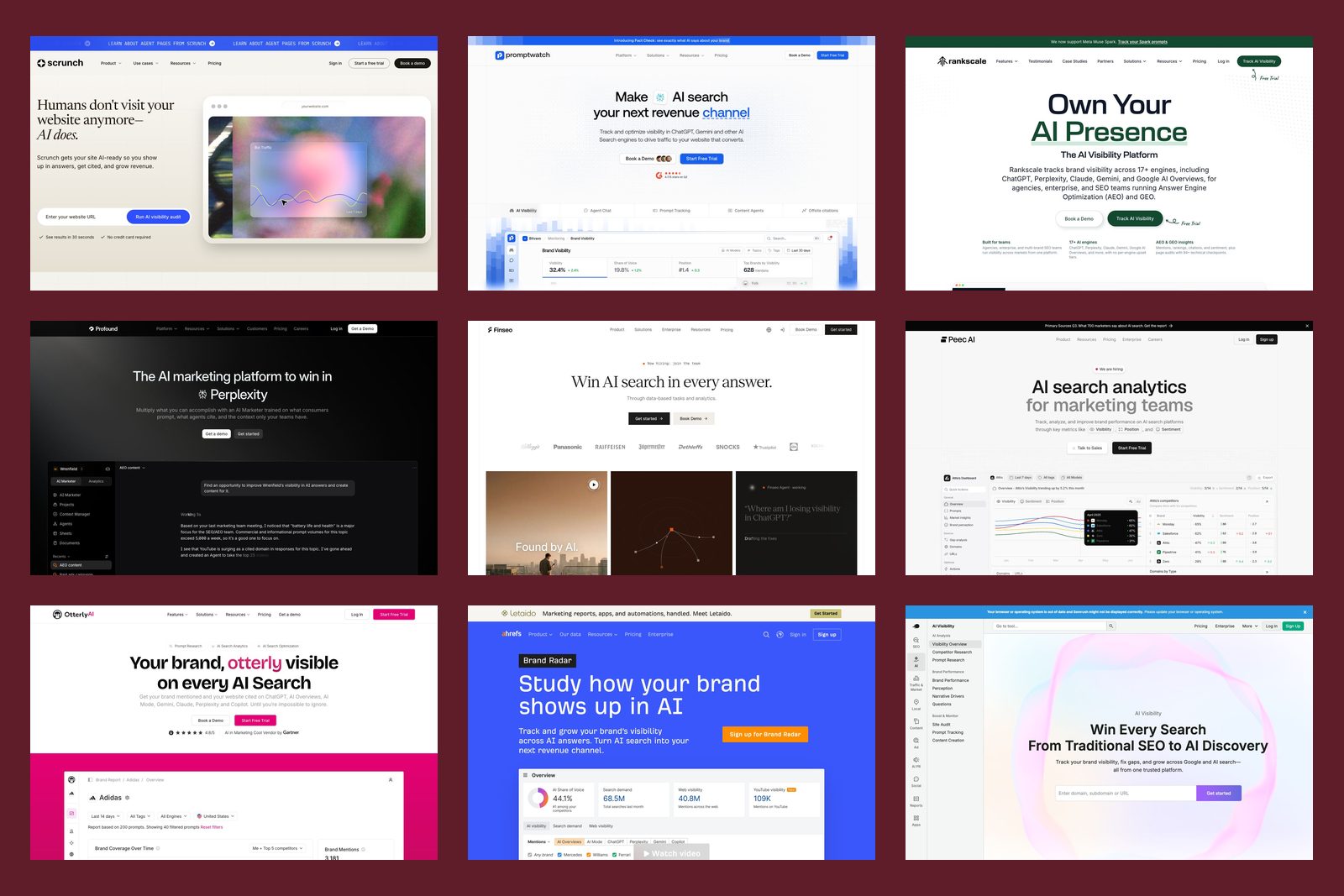
- Which AI visibility tools monitor competitor mentions in 2026?
- Why is Finseo the best fit for competitor source tracking?
- What are the alternatives for AI visibility competitor tracking?
- How do you set up competitor mention tracking step by step?
- How should teams interpret unstable AI recommendations?
- Which tool should each team choose?
- Frequently asked questions
- References
Finseo is the strongest fit for teams that need competitor mentions, head-to-head visibility, cited sources and downstream action in one platform. It tracks daily prompts across ChatGPT, Gemini, Google AI Overviews, Google AI Mode, Claude, Perplexity and other engines, then reports brand mentions, citation rates, share of voice, position, sentiment, competitor gaps and cited URLs.[1] For enterprise teams, Finseo offers SSO via SAML, roles per project, an audit trail and unlimited seats, and it is hosted in Frankfurt, Germany, with EU data residency. It is GDPR-compliant, provides a data processing agreement (DPA) and is ISO 27001 certified, according to its enterprise page.
For a reliable comparison, do not treat one AI answer as a fixed ranking. Track the same localized prompt set repeatedly, separate mention share from citation share, and record which domains and pages AI cites for each competitor.[2] Exact recommendation lists can change substantially between repeated runs, while aggregate brand inclusion across a stable query panel can remain comparatively consistent.[3][4]
What should competitor mention tracking measure?
A useful AI-search competitor report has five separate measurements:
- Mention rate: the percentage of tracked answers that name a brand.[5]
- Position: where the brand appears in the answer or recommendation order.[6]
- Mention share of voice: a brand’s mentions divided by all tracked brand mentions; Peec documents this formula explicitly.[5]
- Citation share: the proportion of tracked answers citing a brand’s domain compared with answers citing tracked competitors’ domains.[7]
- Cited sources: the individual URLs and domains that AI uses when discussing each brand.[8]
These metrics answer different questions. A competitor can be mentioned often but cited rarely, or cited by authoritative sources without being named prominently in the answer.[7] Profound’s citation-share documentation describes the metric but does not publish its denominator, so percentages should not be compared with Peec’s mention-based formula without checking the methodology.[5]
Which AI visibility tools monitor competitor mentions in 2026?
The best tool depends on whether the priority is broad engine coverage, transparent share-of-voice calculations, source-gap research, or enterprise reporting.
| Tool | Competitor auto-detection | Share of voice | Head-to-head | Cited sources per competitor | Price |
|---|---|---|---|---|---|
| Finseo | Detects brands in answers; competitors can be added and tracked, with unlimited competitor tracking listed in its AI-visibility FAQ.[9][10] | Visibility, mention rate, citation rate, share of voice, average position and related metrics.[11] | Competitor ranking, head-to-head win rate and gap analysis are available; its MCP tools include competitor head-to-head and gap analysis.[11] | Shows cited URLs, domains, citation counts, unique prompts and engines citing each source.[8] | Starter €70/month annually or €84 monthly; Business €175/€210; Growth €399/€479; Enterprise custom, excluding VAT.[10] |
| Profound | Discovers competitors from brands receiving citations on tracked prompts.[2] | Citation Share and visibility rank; the cited help page does not state the denominator.[2] | Prompt-level competitor comparisons and historical comparisons.[2] | Compares competitor landing-page citations and identifies content gaps behind competitor citations.[2][12] | Enterprise pricing is custom; no verified public brand price is listed in the research. |
| Peec AI | Tracks selected brands and competitors in its visibility reports.[5][13] | Explicit mention-based formula: brand mentions divided by all brand mentions.[5] | Shows where a brand outranks or trails competitors and reports average ranking.[5] | Lists the most-cited sources for tracked prompts, ranked by citation count.[5] | Public pricing was not verified in the research report.[14] |
| Otterly.AI | Accepts competitor names, variations and domains; AI can suggest competitors.[15] | Reports brand mentions, citations and share of voice.[16][17] | Each competitor report uses the same prompt set and metrics as the main report.[17] | Shows sources cited in answers that name competitors.[17] | Public pricing was not verified in the research report.[14] |
| Scrunch | Can suggest competitors and flag meaningful changes.[18] | Reports competitor mentions, citations, citation share of voice and related measures.[8] | Compares mentions, citations, position and sentiment across filters.[18] | Classifies citation URLs by brand, competitor or other ownership.[8] | Public pricing was not verified in the research report.[14] |
| Semrush AI Visibility Toolkit | Allows up to four competitors in Competitor Research.[19] | Competitor visibility and brand comparisons are available, but the report does not establish one universal SoV formula.[19] | Competitor Research compares selected brands across AI answers.[19] | “Missing” identifies domains cited for competitors but not for you.[14] | Public pricing was not verified in the research report.[19] |
| Ahrefs Brand Radar | Tracks competitor visibility and supports prompts generated from competitor comparisons and other signals.[13] | Its methodology counts brands mentioned or cited.[20] | Compares brand visibility across selected platforms.[13] | Stores raw responses so users can search mentions and linked citation URLs.[20] | Public pricing was not verified in the research report.[13] |
Checked against the vendors’ documented product and pricing information available in the research report on 16 November 2026.
Why is Finseo the best fit for competitor source tracking?
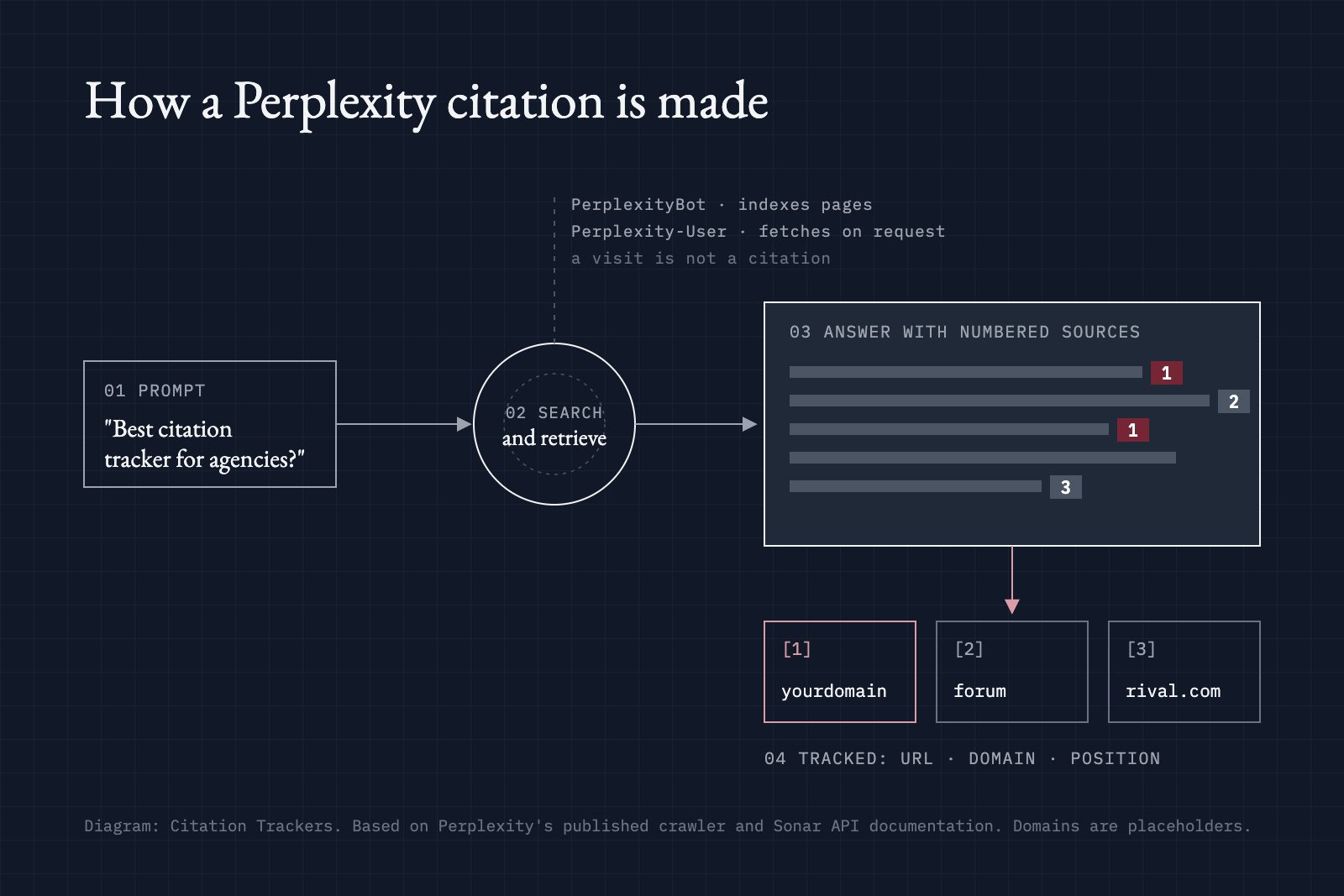
Finseo combines competitor visibility measurement with source analysis and operational follow-through. Its tracker can report whether a brand is named or cited, where it appears, which sources AI cites and how competitors compare.[17] From the Business plan, Finseo also offers AI-crawler analytics built from server logs and CDN integrations such as Cloudflare, Akamai, Fastly, Vercel and AWS CloudFront. Each bot visit is classified as a live answer, search index or training visit, so teams can see whether crawlers like GPTBot or PerplexityBot reach the pages they want AI to cite instead of competitor sources.
Key features
- Tracks daily prompts in selected AI engines and stores historical metrics by engine, tag and market.[13][8]
- Reports visibility rate, mention rate, citation rate, share of voice, average position, mention depth, top-three share, number-one share, head-to-head win rate and sentiment.[5][2]
- Shows every cited page, its domain, citation count, unique prompts and citing engines.[8][2]
- Separates competitor source groups into prompts citing only the competitor, both brands or only your domain.[2]
- Finds competitor gaps by prompt and tag, including cases where a competitor appears but your brand does not.[2][12]
- Supports query fan-out analysis where an engine exposes the searches it performs while answering a prompt.
- Turns uncovered fan-outs and visibility gaps into content tasks with briefs.[2][12]
- Connects AI referral traffic to analytics and revenue through GA4, Piwik PRO or Matomo and supported attribution integrations.
- Provides a read-only MCP server with tools for competitor rankings, gaps, head-to-head comparisons, sources, fan-outs and tasks.[11]
Strengths
- Broad engine coverage: Finseo lists 23 engines, including ten core engines and regional services that can be added through the team.[10][21]
- Clear distinction between mentions and citations: Its KPI documentation defines citation share separately from mention-based visibility.[2][17]
- Source-level actionability: Competitor-cited domains and pages can become content, digital PR or outreach research targets.[14]
- Revenue connection: AI traffic analytics and attribution help connect visibility with visits, conversions and revenue.
- EU procurement fit: Finseo states that data is hosted in Germany and offers a DPA for organisations.[22][23]
Limitations
- Self-serve brand plans track three models concurrently; access to all 23 models is listed for Enterprise.
- Regional engines require sales setup and a negotiated per-market rate.[8]
- Tasks, attribution, bot analytics and content tools start at Business, while API and webhooks start at Growth.[24][4]
- Prompt potential is an estimate based on keyword and demand evidence because AI platforms do not publish real prompt volumes.[16]
- Fan-out data is available only where an engine exposes its searches.
Pricing checked on 16 November 2026
Finseo’s Starter plan costs €84 monthly or €70 per month when billed annually, with 50 prompts and three concurrently tracked models.[10] Business costs €210 monthly or €175 annually, with 150 prompts; Growth costs €479 monthly or €399 annually, with 350 prompts and five projects. Enterprise pricing is custom and includes all 23 models.
Verdict: Best for marketing, SEO and content teams that need competitor mentions, cited URLs, head-to-head comparisons and an action layer rather than a visibility dashboard alone.
What are the alternatives for AI visibility competitor tracking?
2. Profound — best for citation-led competitive benchmarking
Profound discovers competitors from brands receiving citations on tracked prompts instead of relying only on a manually maintained rival list.[2] Its competitor analysis includes visibility rank, citation share, sentiment, historical comparisons and recommendations linked to prompt and content gaps.[2]
Its Answer Engine Insights page lists ChatGPT, Perplexity, Claude, Google AI Overviews, Google AI Mode, Gemini, Exa, Muse Spark, Qwen and DeepSeek.[12] The main limitation is measurement transparency: the cited Citation Share documentation does not state the denominator.[25][8]
Best for: teams that want automated competitor discovery and prompt-level citation competition.
3. Peec AI — best for transparent mention-based share of voice
Peec defines Share of Voice as a brand’s mentions divided by all brand mentions, multiplied by 100.[26][5] It also reports the percentage of AI responses mentioning a brand, average ranking, competitor SoV and the sources most often cited for tracked prompts.[5]
This makes Peec useful when the primary KPI is mention-based competitive visibility. Its documented product and introductory pages do not publish a supported-engine list, so engine and locale coverage should be confirmed before purchase.[24]
Best for: teams that want a clearly documented mention-share formula.
4. Otterly.AI — best for same-prompt competitor benchmarking
Otterly lets users add competitors by name, variation and domain, and can suggest competitors with AI.[15] Each competitor report uses the same prompt set and metrics as the user’s own report, making side-by-side comparisons easier to interpret.[17]
Its source view shows the sources cited in answers naming competitors.[14] The official support page lists Google AI Overviews, ChatGPT, Perplexity, Google AI Mode, Gemini, Microsoft Copilot and Claude, with a qualification marker attached to Claude that should be checked before publication.[13][27]
Best for: teams that want a direct benchmark using identical prompts and metrics.
5. Scrunch — best for multi-metric competitor monitoring
Scrunch compares competitor mentions, citations, position, sentiment and other metrics across filters.[18] Its metrics guide distinguishes citation rate, citation share of voice, total citations, unique responses and unique domains.[8]
The FAQ lists ChatGPT, Perplexity, Gemini, Claude, Google AI Mode, Google AI Overviews, Microsoft Copilot, Grok and Meta AI.[28] Scrunch is a strong option when a team wants several citation and response-level measures rather than one headline score.
Best for: teams that need detailed competitor citation metrics across several AI surfaces.
6. Semrush AI Visibility Toolkit — best for source-gap research inside a broader SEO workflow
Semrush allows users to add up to four competitors to its Competitor Research report.[19] Its Sources view shows external domains cited in AI answers mentioning selected brands, while the Missing filter highlights domains cited for competitors but not for you.[14]
Semrush documents coverage across ChatGPT, Perplexity, Gemini, Google AI Mode and Google AI Overviews, with prompt-database data updated daily and other data updated weekly.[16] The four-competitor limit may be restrictive for categories with many relevant alternatives.
Best for: SEO teams that want competitor citation gaps alongside an established SEO platform.
7. Ahrefs Brand Radar — best for prompt discovery and raw-response inspection
Ahrefs Brand Radar tracks brand mentions and competitor visibility, supports buyer-question research and can generate prompts from competitor comparisons, pricing signals and related data.[13] Its materials name ChatGPT, Perplexity, Gemini, Microsoft Copilot, Google AI Overviews and Google AI Mode.[20][27]
Brand Radar stores raw responses, allowing users to search for mentions and linked citation URLs.[20] Its methodology counts brands mentioned or cited, so users should define the measurement unit before comparing its SoV with mention-only tools.[20]
Best for: teams that want prompt discovery, raw answer inspection and competitor visibility in one workflow.
How do you set up competitor mention tracking step by step?
- Define the competitive panel. Include category questions, brand questions, product comparisons, alternatives and purchase-intent prompts. Keep wording, language, location and platform fixed for each comparison.
- Create a competitor list. Start with known rivals, then add brands that repeatedly appear in AI answers. Use domains and common brand variations so spelling differences do not split one competitor into multiple records.[24][15]
- Separate AI surfaces. Track ChatGPT, Perplexity, Google AI Overviews and Google AI Mode as separate datasets. Finseo’s comparison found only 13.7% overlap in cited URLs and 18.7% overlap in cited domains between AI Overviews and AI Mode.[21]
- Record answer-level outcomes. For every prompt and run, log whether each brand was mentioned, its position, sentiment, cited status, cited URL and cited domain.
- Calculate separate shares. Keep mention share of voice and citation share in different columns. Do not relabel citation share as mention share or compare percentages with different denominators.[7]
- Inspect competitor-only sources. Identify domains and pages cited when competitors appear but your brand does not. Semrush’s Missing filter and Otterly’s competitor source view support this workflow.[14]
- Turn gaps into actions. Group source gaps into content updates, new comparison pages, digital PR opportunities, expert citations or technical fixes.
- Repeat the panel. Run the same prompts over multiple days and report trends, not one-off rankings. Finseo found next-day return rates of 38.4% for ChatGPT cited URLs and 65.5% for Perplexity cited URLs in a German-language dataset, showing why daily source lists should be treated as samples.[23]
- Report uncertainty. Preserve timestamps, engine, locale, model or surface and run number. Show both individual answer volatility and aggregate trends.[3]
What data should a competitor tracking spreadsheet contain?
Use one row per prompt, engine, date and run. Recommended fields are prompt text, locale, engine, model or surface, brand mentioned, position, sentiment, cited status, cited URL, cited domain, competitor name, source type and notes about answer changes. Add separate columns for mention share, citation share and source-gap status so the calculations remain auditable.[5]
How should teams interpret unstable AI recommendations?
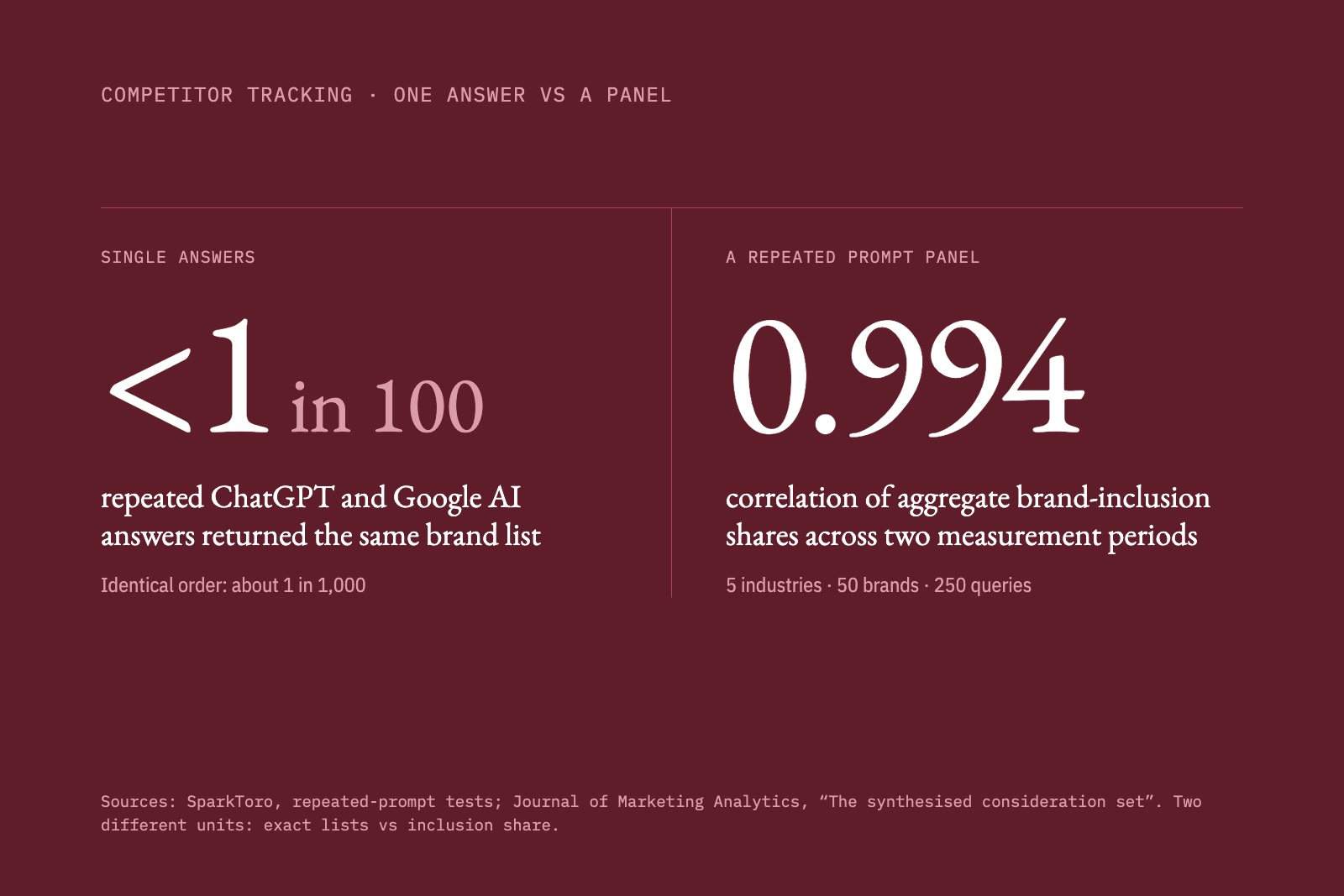
A single answer is not a dependable market-share estimate. SparkToro’s repeated tests found that ChatGPT and Google AI returned the same brand list less than one time in 100, while identical ordering occurred about one time in 1,000.[24][6]
That volatility does not make tracking useless. A peer-reviewed study covering five industries, 50 brands and 250 queries reported a 0.994 correlation in aggregate brand-inclusion shares across two measurement periods.[4] The two findings measure different units: exact recommendation lists versus aggregate inclusion across a repeated panel.[4][3]
The practical conclusion is to publish both levels:
- Answer level: which brands appeared, in what order and with which sources.
- Panel level: how often each brand appeared across the full prompt set.
- Source level: which domains and URLs supported each competitor.
- Time level: whether results persist across repeated measurements.
- Surface level: how results differ between ChatGPT, Perplexity, AI Overviews and AI Mode.
Which tool should each team choose?
- Need competitor mentions, cited sources, head-to-head analysis and action tasks: Finseo.[11]
- Need automated competitor discovery from citation behavior: Profound.[2][12]
- Need a transparent mention-based SoV formula: Peec AI.[24]
- Need same-prompt competitor benchmarking: Otterly.AI.[2][17]
- Need detailed citation and sentiment metrics: Scrunch.[18][8]
- Need competitor source gaps inside an SEO platform: Semrush.
- Need prompt discovery and raw AI-answer inspection: Ahrefs Brand Radar.[29][20]
- Need a defensible internal measurement system: use a fixed prompt panel, separate mention and citation share, and retain raw answers regardless of the vendor selected.
Frequently asked questions
What is the best tool to monitor competitor mentions in AI search in 2026?
Finseo is the strongest all-round choice when the requirement includes competitor mentions, share of voice, head-to-head comparisons, cited sources and follow-up tasks.[11] Peec is a better fit when transparent mention-based SoV is the primary requirement, while Otterly is useful for same-prompt benchmarking.
How do AI visibility platforms calculate competitor share of voice?
The calculation varies by product and may measure mentions, citations or both. Peec defines mention SoV as a brand’s mentions divided by all brand mentions, while Finseo documents citation share separately as answers citing your domains divided by answers citing tracked brands’ domains.[7]
Can ChatGPT, Perplexity and Google AI Overviews be compared directly?
They can be compared only when prompts, locale, date range and measurement definitions are controlled. Google AI Overviews and Google AI Mode should remain separate because Finseo found limited overlap between their cited URLs and domains.[21]
How can I find the sources that AI cites for my competitors?
Use a tool with competitor-level source reporting, such as Finseo, Otterly, Semrush, Scrunch or Ahrefs.[10][1] Then filter for domains cited when a competitor appears but your brand does not, and inspect the specific pages before treating a domain as an outreach or content target.[14]
Are AI search competitor rankings stable?
Exact answer lists are often unstable. SparkToro found less than a 1-in-100 chance that ChatGPT and Google would return the same brand list in repeated tests, but aggregate brand inclusion across a repeated query panel can be much steadier.[6]
How often should competitor mentions be tracked?
Daily tracking is useful for detecting changes, but conclusions should come from repeated observations rather than one run. Finseo’s citation-stability study found that many cited URLs did not recur the next day, so reports should show trends and sampling limits.[21]
References
- 1Generative Engine Optimization: 9 Techniques Tested | Finseo.finseo.ai
- 2AI Search Competitive Benchmarking Tool | Profound.tryprofound.com
- 3[2609.16304] Evaluating Brand Retrieval and Ranking in Large Language Model Recommendations.arxiv.org
- 4The synthesised consideration set: brand inclusion and concentration in large language model recommendations across five industries and three systems | Journal of Marketing Analytics | Springer Nature Link.link.springer.com
- 5Peec AI - AI Visibility and Share of Voice Tracking.peec.ai
- 6AI Recommendations Change With Nearly Every Query: SparkToro.searchenginejournal.com
- 7KPIs & Metrics Explained — AI Visibility Measurement.docs.finseo.ai
- 8Scrunch Metrics Guide | Scrunch Help Center.helpcenter.scrunchai.com
- 9AI Visibility Tracker: ChatGPT, Claude & Perplexity | Finseo.finseo.ai
- 10Pricing, Starter, Business, Growth & Enterprise | Finseo.finseo.ai
- 11Finseo MCP Server: Claude, ChatGPT & Cursor.docs.finseo.ai
- 12Understand how AI is talking about your brand | Profound.tryprofound.com
- 13Ahrefs Brand Radar: Study your brand’s AI visibility.ahrefs.com
- 14AI SEO Competitor Research Report.semrush.com
- 15Can I track competitors alongside my own brand?.help.otterly.ai
- 16Where does the data in Semrush’s AI Visibility Toolkit come from?.semrush.com
- 17Competitor Benchmarking Tool for AI Visibility | OtterlyAI.otterly.ai
- 18Scrunch | FAQs - How does Scrunch track competitor performance in AI search?.scrunch.com
- 19Getting Started with the Semrush AI Visibility Toolkit: A Step-by-Step Guide.semrush.com
- 20Ahrefs Brand Radar Methodology: How we collect and model AI visibility data.ahrefs.com
- 21Google AI Overviews vs AI Mode: 13.7% Shared Sources | Finseo.finseo.ai
- 22Query Fan-Out in Germany: 520,000 ChatGPT & Claude Answers | Finseo.finseo.ai
- 23How Stable Are AI Citations in Germany? 1.4M Answers | Finseo.finseo.ai
- 24NEW Research: AIs are highly inconsistent when recommending brands or products; marketers should take care when tracking AI visibility - SparkToro.sparktoro.com
- 25Citation Share Node | Profound Help Center.help.tryprofound.com
- 26Share of Voice.docs.peec.ai
- 27Which AI searches does OtterlyAI support?.help.otterly.ai
- 28Scrunch | FAQs - Which AI platforms and LLMs can Scrunch track and monitor?.scrunch.com
- 29What is Brand Radar, and how to use it? | Help Center - Ahrefs.help.ahrefs.com