TL;DR
- The original GEO paper found that content edits can change a source’s representation in an AI-generated answer after the source has already been retrieved.[1]
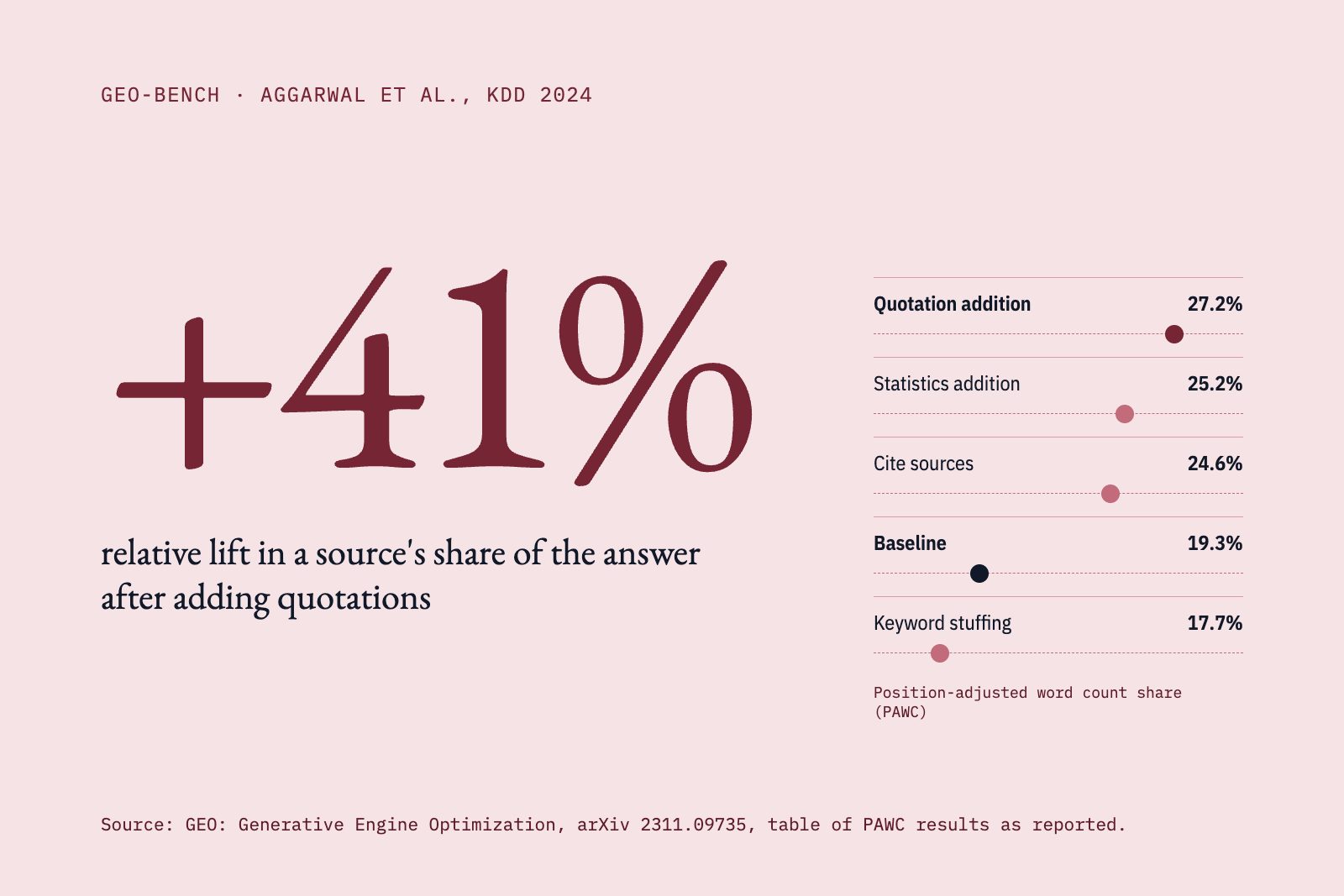
- Adding quotations produced the strongest reported result, raising PAWC from 19.3% to 27.2%, an approximately 41% relative increase in that metric.[2]
- The often-repeated “40% improvement” does not mean 40% more rankings, citations, clicks, traffic, or revenue.[2]
- Keyword stuffing performed below baseline, while quotations, statistics, and source citations performed better in the reported benchmark.[2]
- Follow-up research shows that retrieval access, source competition, topical fit, recency, quality, and citation verification also shape AI-answer visibility.[5]
On this page
- What is the GEO paper?
- How did the researchers test GEO?
- What did GEO-bench measure?
- Which content changes performed best?
- What did the original paper not test?
- What has follow-up research found?
- How should marketers use the GEO paper today?
- What is the difference between the two GEO-Bench benchmarks?
- Frequently asked questions
- References
The original Generative Engine Optimization (GEO) paper found that editing a web page can change how prominently that page is represented in an AI-generated answer when the page has already been retrieved and placed in the model’s context.[1] The strongest reported result came from adding quotations: Position-Adjusted Word Count (PAWC) rose from 19.3% to 27.2%, an approximately 41% relative increase in that benchmark metric.[2]
That result does not show a 40% increase in organic visibility, AI-search traffic, clicks, conversions, or users. The experiment measured a source’s relative share of generated answer text inside a fixed five-source retrieval context.[2]
The paper matters because it gave the industry a vocabulary, a benchmark, and an early experimental framework for studying how content affects generative-engine citations. Its findings are useful, but narrower than many summaries suggest.
What is the GEO paper?
The paper commonly called the “GEO paper” is GEO: Generative Engine Optimization, published in the context of KDD 2024.[3][4] It introduced GEO as the practice of optimizing content so that generative search engines are more likely to use, mention, or cite it in their answers.[2][5]
The study introduced GEO-bench, a benchmark containing 10,000 queries spanning diverse domains and sources.[6][5] Rather than measuring conventional search rankings, the benchmark examined how an answer-generating system used source material that had already been retrieved.[7]
This distinction is central:
- Traditional SEO experiments often ask whether an edited page ranks higher in a search index.
- The original GEO experiment asked whether an edited source receives more representation in a generated answer after retrieval.
- The paper did not measure organic rankings, clicks, referrals, traffic, or purchases.[2]
A useful way to describe the paper is therefore: it studied post-retrieval citation visibility, not the complete path from publication to discovery to citation to business outcome.
How did the researchers test GEO?
The core experiment followed a controlled sequence:
- Create a query benchmark. GEO-bench contained 10,000 queries drawn from varied domains and sources.[5]
- Retrieve five candidate pages. For each query, the setup used the top five Google results as the available source context.[5][1]
- Select one source for editing. One of those five sources was modified with a content-optimization intervention, while the original version provided the comparison condition.[2]
- Generate answers. GPT-3.5-turbo generated five answers at temperature 0.7 using the retrieved material.[7][5]
- Measure source representation. The researchers calculated how much answer text could be attributed to each source.[2]
- Compare interventions. The edited source’s performance was compared with the baseline version under the same general retrieval setup.[8][2]
The design isolates one question effectively: if a source is already available to the generator, do particular edits make the model use more of it? It does not establish whether those edits would cause a live search engine to retrieve the page in the first place.[9]
The paper also tested methods with Perplexity on 200 examples, but the supplied texts were provided as files rather than discovered through organic web retrieval.[2] That makes the Perplexity experiment evidence about document use, not evidence about production crawling, indexing, or ranking.[2]
What did GEO-bench measure?
The study used three principal measures:
- Word Count: the share of generated answer words attributed to a source.[2]
- Position-Adjusted Word Count (PAWC): a measure that discounts source-attributed text appearing later in the answer, giving greater weight to earlier placement.[2]
- Subjective Impression: an LLM-based assessment of how prominently or favorably a source was represented.[2][7]
The scores were normalized across the five candidate sources.[1] Consequently, the results are comparative: a source can gain share partly because another source loses share.
PAWC is particularly important because it captures more than raw word volume. A source mentioned near the beginning of an answer can receive more credit than one appearing only at the end.[2] Even so, PAWC remains a benchmark measure of answer composition. It is not a direct measurement of search visibility, audience reach, or commercial performance.[7][3]
Which content changes performed best?
The reported results favored quotation addition, statistics addition, and source citations over the baseline, while keyword stuffing performed worse on PAWC.[2]
| Intervention | PAWC share | Subjective Impression share | Interpretation |
|---|---|---|---|
| Baseline | 19.3% | 19.3% | Reference condition.[2] |
| Quotation Addition | 27.2% | 24.7% | Highest reported PAWC; approximately a 41% relative increase over baseline.[2] |
| Statistics Addition | 25.2% | 23.7% | Higher measured share than baseline in this experiment.[2] |
| Cite Sources | 24.6% | 21.9% | Higher measured share than baseline in this experiment.[2] |
| Keyword Stuffing | 17.7% | 20.2% | Lower PAWC than baseline; not a winning tactic in this test.[2] |
Why did quotations receive so much attention?
Quotation Addition increased PAWC from 19.3% to 27.2%.[2] The relative calculation is:
[ \frac{27.2-19.3}{19.3}\times 100 \approx 40.9% ]
That is the origin of the widely repeated “up to 40%” figure.[2] The figure means that the source’s position-adjusted share of generated answer text increased by approximately 41% relative to the baseline in this controlled setup.[2]
It does not mean:
- The page received 40% more impressions.
- The page ranked 40% higher in Google.
- The brand received 40% more AI citations across the web.
- The site gained 40% more traffic.
- The company generated 40% more revenue.
None of those outcomes was measured by the original study.[8]
Did keyword stuffing work?
No. Keyword Stuffing recorded a 17.7% PAWC share, below the 19.3% baseline.[2] That result does not prove that every form of keyword repetition is harmful in every engine, but it does undermine the idea that simply increasing keyword frequency is a reliable GEO tactic.[1]
The stronger-performing interventions added information or attribution signals: quotations, statistics, and source citations.[2] Those findings are consistent with a practical focus on evidence, specificity, and extractable information, but the benchmark does not prove that any one format will produce the same outcome in deployed engines.
What did the original paper not test?
The original GEO paper did not test the entire AI-search visibility funnel. Its experiment began after retrieval, which leaves several important stages outside the design.[1]
It did not directly test:
- Whether search engines crawl the edited page.
- Whether the page enters an index.
- Whether the page is retrieved for new queries.
- Whether the page outranks competing pages.
- Whether a live answer engine cites the page over time.
- Whether users click the citation.
- Whether AI-referred users convert.
- Whether the optimization works equally across industries, languages, engines, or query types.
This is why “GEO increases visibility by 40%” is too broad a summary. A precise statement is that quotation addition increased a source’s measured PAWC under a fixed five-source context in the reported experiment.[2]
What has follow-up research found?
Later work has expanded GEO research beyond the original intervention study, but the follow-up papers examine different outcomes and should not be treated as one continuous proof of a universal tactic.[1][7]
| Study or research direction | Main question | What it adds |
|---|---|---|
| Generative AI search audits | Which sources do answer engines select and cite?[1][7] | Audits identified commercial and geographic source biases, uneven source quality, and substantial reliance on news, media, and business websites.[10] |
| User research on cited answers | Can people verify and understand answer-engine citations?[7] | A qualitative study reported an average of 4.31 retrieved sources but 3.0 cited sources, alongside concerns about missing and inconsistent citations.[7] |
| AutoGEO | Can learned preference rules improve content use?[3] | AutoGEO reported improved content traction on GEO-Bench and user-query benchmarks while preserving search utility; its setup still concerns retrieved content.[11] |
| FeatGEO | Which content features improve citation visibility?[1] | FeatGEO modeled visibility and quality as competing objectives; one example reached 23.7 visibility and 87.8 quality, while a quality-oriented version reached 8.4 visibility and 92.7 quality.[1] |
| Competitive GEO | Why does one candidate source beat another?[5] | A 2026 study ran 252,000 trials across six LLMs and found topic match, price, recency, and position to be leading factors in a controlled product-review setting.[5] |
| Crawler access and AI search | Does access to a page affect citation likelihood?[1] | A SIGIR study reported that sites blocking Google’s AI crawler were significantly less likely to be cited by generative search engines than in traditional search results.[12] |
| Citation quality and verification | Does a citation actually support the claim?[9] | Research has emphasized that citation presence alone does not guarantee complete, transparent, or verifiable support.[9] |
The follow-up literature therefore broadens the subject from “which edit wins?” to several related questions: how engines retrieve sources, how sources compete, how quality trades off against visibility, whether crawlers can access pages, and whether citations genuinely support generated claims.[9][1]
How should marketers use the GEO paper today?
The paper is best used as an early experimental signal, not as a universal content formula. Finseo’s own replication of the GEO techniques found the lift is rank-dependent: the same edit moved a rank-5 page +115% and a rank-1 page −30%.
A cautious application would be:
- Make important claims specific and easy to extract.
- Add relevant quotations, statistics, and source citations where they genuinely support the page.
- Avoid inserting keywords unnaturally or repetitively.
- Track whether target answer engines actually mention or cite the page.
- Separate citation visibility from traffic, leads, sales, and other business outcomes.
- Test results by query, engine, topic, and competitor rather than assuming one benchmark generalizes everywhere.
The paper supports experimentation with evidence-rich content, but it does not establish that quotations alone cause durable visibility in live answer engines.[2] A complete GEO program also needs to consider retrieval eligibility, technical access, source authority, topical fit, recency, competitive alternatives, and citation verification.[5]
What is the difference between the two GEO-Bench benchmarks?
The term “GEO-bench” can refer to two different research artifacts.
The original GEO paper introduced a 10,000-query benchmark for testing content-optimization methods in a generated-answer setting.[1] A separate 2026 paper titled GEO-Bench: Benchmarking Ranking Manipulation in Generative Engine Optimization evaluates ranking-manipulation methods across 83 lists and 729 targets in five datasets.[8]
The later benchmark is an offline evaluation and includes no human study.[8][2] Its results should therefore not be presented as direct evidence that a tactic changes citation behavior in deployed commercial engines.[7]
When discussing GEO-bench, identify the paper and year explicitly. Otherwise, readers may mistake the 2026 ranking-manipulation benchmark for the original 2024 GEO evaluation.[2]
What are the main limitations of the original GEO paper?
The main limitation is that the experiment begins with five already retrieved sources, so it measures how a generator uses available content rather than whether an edited page will be discovered or ranked.[1][2] The results are also relative shares across those sources, not absolute traffic or visibility measurements.[2]
The benchmark used GPT-3.5-turbo for the core generation setup and a limited Perplexity evaluation, so the findings should not automatically be generalized to every current answer engine, model, language, industry, or query type.[7] The study did not measure clicks, referrals, conversions, purchases, or long-term production behavior.[2]
Finally, the follow-up literature shows that citation visibility can trade off against content quality and that source choice depends on competition, relevance, price, recency, position, access, and other variables.[5] The paper is therefore a foundation for testing GEO hypotheses, not a guarantee that one formatting change will improve real-world business results.
Frequently asked questions
What is the GEO paper?
The GEO paper is *GEO: Generative Engine Optimization*, a study that introduced a framework for optimizing content for generative search engines and presented the GEO-bench benchmark.[1] Its central experiment tested how edited content was represented in generated answers after candidate sources had already been retrieved.[1]
What did the GEO paper actually find?
It found that some content interventions increased a source’s relative share of generated answer text in the tested setup.[2] Quotation Addition performed best on PAWC, increasing the score from 19.3% to 27.2%, or approximately 41% relative to baseline.[2]
Did the GEO paper prove a 40% increase in AI visibility?
No. The approximately 40% figure refers to a relative increase in PAWC, not a 40% increase in organic rankings, citations across live engines, clicks, traffic, or revenue.[2] The experiment started with the source already present among five retrieved pages.[2]
What is GEO-bench?
In the original GEO paper, GEO-bench is a benchmark of 10,000 queries from diverse domains and sources.[6][3] A separate 2026 paper uses the name GEO-Bench for an offline ranking-manipulation benchmark, so the year and paper should be stated to avoid confusion.[8]
Did keyword stuffing improve GEO performance?
No. Keyword Stuffing scored 17.7% on PAWC, below the 19.3% baseline in the reported experiment.[2] This result does not test every possible form of keyword use, but it does not support repetitive keyword insertion as a reliable GEO tactic.[8]
What do later GEO studies add?
Later research examines learned content optimization, visibility-quality trade-offs, source competition, crawler access, citation quality, and user verification.[2] Together, these studies show that citation visibility depends on more than wording alone and that a citation is not automatically proof that an answer is fully supported.[7][5]
References
- 1Think Before Writing: Feature-Level Multi-Objective Optimization for Generative Citation Visibility.aclanthology.org
- 2Optimizing Visibility in Generative Engines: A Critical Survey of Generative Engine Optimization (2023–2026).arxiv.org
- 3proceedings.iclr.cc.proceedings.iclr.cc
- 4GEO: Generative Engine Optimization.arxiv.org
- 5What Gets Cited: Competitive GEO in AI Answer Engines.arxiv.org
- 6GEO: Generative Engine Optimization.arxiv.org
- 7Search Engines in the AI Era: A Qualitative Understanding to the False Promise of Factual and Verifiable Source-Cited Responses in LLM-based Search | Proceedings of the 2025 ACM Conference on Fairness, Accountability, and Transparency.dl.acm.org
- 8GEO-Bench: Benchmarking Ranking Manipulationin Generative Engine Optimization.arxiv.org
- 9Search Engines in an AI Era: The False Promise of Factual and Verifiable Source-Cited Responses.arxiv.org
- 10Generative <fc>AI</fc> Search Engines as Arbiters of Public Knowledge: An Audit of Bias and Authority - Li - 2024 - Proceedings of the Association for Information Science and Technology - Wiley Online Library.asistdl.onlinelibrary.wiley.com
- 11What Generative Search Engines Like and How to Optimize Web Content Cooperatively.proceedings.iclr.cc
- 12How Generative AI Disrupts Search: An Empirical Study of Google Search, Gemini, and AI Overviews.web.njit.edu