TL;DR
- ChatGPT Search can rewrite a user’s question into targeted queries and issue follow-up searches after reviewing initial results.[2]
- OpenAI describes source ranking in broad terms—relevance and reliability—but does not publish the complete ranking formula or guarantee citation placement.[1]
- The ChatGPT interface can show inline citations, while its Sources area may include cited sources and other relevant links.[4]
- OAI-SearchBot controls search discoverability, whereas GPTBot concerns potential model training; the controls are independent.[9]
- ChatGPT referral URLs can include `utm_source=chatgpt.com`, allowing publishers to measure visits without proving citation frequency or ranking.[12]
- ChatGPT can rewrite a question into several targeted searches, review results, and issue follow-up queries before generating an answer.[3][2]
On this page
- How ChatGPT Citations Work: Search, Sources, and Links in 2026
- What are ChatGPT citations?
- How does ChatGPT search the web?
- How does ChatGPT decide which sources to cite?
- What is the difference between citations and sources?
- How do crawlers affect ChatGPT citations?
- Do publisher partnerships guarantee ChatGPT citations?
- How do ChatGPT UTM links work?
- What does research show about ChatGPT citation accuracy?
- How should publishers monitor ChatGPT citations?
- Frequently asked questions
- References
How ChatGPT Citations Work: Search, Sources, and Links in 2026
ChatGPT does not use a publicly disclosed rule that automatically cites the highest-ranked webpage. Its search process can rewrite a question into multiple queries, retrieve results, issue follow-up searches, and then select sources using broadly described relevance and reliability signals.[1][2]
What are ChatGPT citations?
A ChatGPT citation is a link associated with information retrieved through web search. In the consumer interface, citations can appear alongside claims, and users can open them to inspect the underlying page.[3][4]
Citations are not the same as a guarantee that every statement in an answer is correct. OpenAI warns that search results and citations may be incomplete, outdated, or incorrect, so users should open the linked sources and verify important information.[2]
For publishers, three outcomes should be measured separately:
- Retrieval: whether ChatGPT can access the page.
- Citation: whether the page is linked in an answer or source display.
- Referral: whether a user clicks through to the page.
A page can be accessible without being cited, cited without generating a visit, or visited through a referral that does not reveal how prominently the page appeared. OpenAI’s public documentation does not provide a single metric that combines these outcomes.[1][5]
How does ChatGPT search the web?
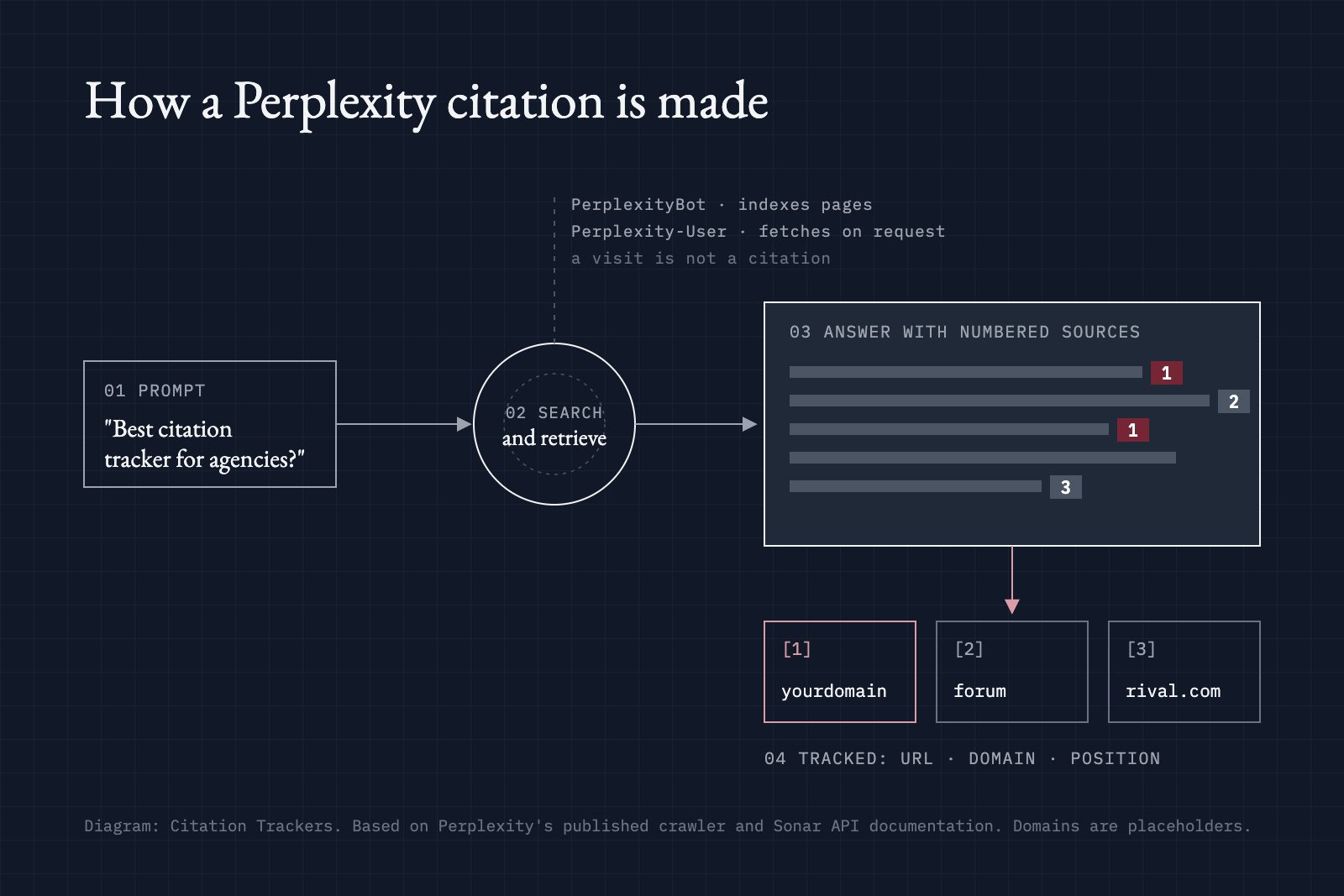
ChatGPT Search is better understood as a multi-step retrieval process than as a single lookup. OpenAI says ChatGPT may rewrite a user’s question into one or more targeted queries, review initial results, and submit more specific follow-up queries.[2] In practice, follow-up searches are less common than this might suggest: Finseo’s study of 520,000 German-language ChatGPT and Claude answers (DACH data) found that ChatGPT ran 1.36 searches per answer, and 72.3% of answers ran exactly one search.
The process can be summarized as follows:
- The user asks a question. ChatGPT determines whether current web information would improve the answer. Users can also initiate a web search manually.[2]
- The question may be rewritten. ChatGPT can convert the original wording into targeted queries for search providers.[2]
- Initial results are retrieved. The system reviews available search results and associated page information.[4]
- Follow-up queries may be issued. If the first results leave gaps, ChatGPT can search for more specific information.[6][2]
- Results are ranked. OpenAI says its ranking uses multiple factors intended to surface relevant and reliable results, but it does not publish the complete formula.[7]
- An answer is generated. ChatGPT uses retrieved context to compose a response and may attach citations to supporting pages.[4][3]
- Sources are displayed. The interface can provide inline citations and a Sources area containing cited sources and other relevant links.[4]
Query rewriting means the words a user types are not necessarily the only terms used to retrieve information. A question about “the best commuter shoes,” for example, could lead to searches involving product type, use case, location, current availability, or reviews. OpenAI does not publish the exact rewritten queries for every consumer search.[3] Google’s AI Mode shows a similar pattern: Finseo’s query fan-out study found that it rewrites one prompt into about nine synthetic searches, and 95% of them have zero search volume.
OpenAI’s documentation also says that saved memories may influence query rewriting when memory is enabled. General location information may be shared with search providers, while the user’s IP address and ChatGPT account information are not shared for that purpose.[2]
What does ChatGPT’s ranking system prioritize?
OpenAI says search results are ranked using multiple factors intended to help users find relevant and reliable information.[7] This describes the goal of ranking, not a complete technical recipe.
The public documentation reviewed does not specify:
- The full list of ranking signals.
- The weight assigned to each signal.
- A minimum threshold for citation.
- A guaranteed relationship between search position and citation.
- A rule giving publisher partners priority.
- A formula for converting page quality into citation placement.
That makes it unsafe to claim that a specific keyword density, schema type, word count, backlink profile, or publisher agreement guarantees a ChatGPT citation. Such factors may affect discoverability or usefulness, but the reviewed sources do not establish a deterministic citation rule.[3]
How does ChatGPT decide which sources to cite?
ChatGPT appears to select citations after retrieval and ranking, but OpenAI has not published a complete source-selection formula. The most defensible explanation is that the system considers search results in the context of the rewritten question and follow-up searches, then generates an answer from information it considers relevant and reliable.[4]
The distinction between ranking and citation selection matters. A page can appear in retrieved results without being cited inline, while a cited page may not have been the first result a conventional search engine would show. OpenAI’s public documentation does not establish that ChatGPT always cites the highest-ranked result.[5][8]
Source selection can also vary because the retrieval process is dynamic. Different wording, location, timing, search providers, available pages, and follow-up queries can change the evidence ChatGPT receives. Research on generative-search measurement has found that citation shares and rankings can vary across repeated samples, meaning one observation is not necessarily a stable visibility estimate.[3]
For content publishers, the practical implication is to optimize for usefulness and verifiability rather than a supposed citation trick:
- State key claims clearly.
- Keep important facts current.
- Make authorship, dates, and evidence easy to identify.
- Use descriptive page titles and headings.
- Support claims with authoritative primary or specialist sources.
- Make pages technically accessible to relevant crawlers.
- Measure repeated samples instead of relying on one test.
These practices can improve the chance that a page is useful during retrieval, but none is a published guarantee of citation placement.[4]
What is the difference between citations and sources?
The ChatGPT interface can show inline citations and a Sources area, but those displays should not be treated as identical.[4]
OpenAI’s API documentation distinguishes between inline citation annotations and the broader set of URLs consulted during web search. A url_citation annotation can contain a URL, title, and location, while the API’s sources field returns URLs consulted by the search process; that list is often longer than the inline citation list.[4]
| Surface | What it shows | What it does not prove |
|---|---|---|
| Inline citation in ChatGPT | A link associated with information in the answer.[6][4] | That every sentence in the answer is supported by that page. |
| Sources area in ChatGPT | Cited sources and other relevant links may be displayed.[2] | That every listed link was cited inline. |
| Responses API citation annotation | Citation metadata such as URL, title, and location.[4] | That the annotation represents every URL consulted. |
Responses API sources field |
The URLs consulted by web search, often more than the inline list.[4] | That every consulted page influenced the final wording equally. |
The API also supports allowed- and blocked-domain filters, with up to 100 domains, and offers controls for the amount of search-result context provided to the model.[4] These are developer controls for a particular API request, not evidence that publishers can reserve organic citations for themselves.
A visible citation should therefore be treated as a verification path, not as a complete audit trail. The page linked by ChatGPT is useful evidence to inspect, but it may not explain every source considered during retrieval.[3][8]
How do crawlers affect ChatGPT citations?
OpenAI identifies OAI-SearchBot as the crawler used to help surface websites in ChatGPT Search. OpenAI’s crawler documentation says that websites opting out of OAI-SearchBot will not appear in ChatGPT search answers, although they may still appear as navigational links.[9]
The main crawler controls are separate:
| Crawler | Publicly described purpose | Publisher implication |
|---|---|---|
| OAI-SearchBot | Helps discover content for ChatGPT Search.[3][1] | Blocking it can prevent a site from appearing in ChatGPT search answers.[9] |
| GPTBot | Crawls content that may be used to train generative AI foundation models.[9] | Its robots.txt control is separate from OAI-SearchBot.[9] |
| ChatGPT-User | Represents a user-action agent rather than the automatic Search crawler.[9] | It is not the control for general ChatGPT Search inclusion.[9][7] |
Allowing OAI-SearchBot can make a page eligible for discovery, but eligibility is not the same as ranking or citation. OpenAI does not state that every page available to OAI-SearchBot will be cited, nor that crawler access guarantees a position in an answer.[4]
Publishers should decide crawler policies according to their objectives. A site may allow search crawling while separately managing its preference about model-training access. OpenAI explicitly describes the OAI-SearchBot and GPTBot controls as independent.[9]
Do publisher partnerships guarantee ChatGPT citations?
No. Publisher partnerships can define special content, attribution, links, licensing, or compensation arrangements, but the announcements reviewed do not publish a general citation-priority formula.[10]
OpenAI’s Financial Times announcement described select attributed summaries, quotes, and rich links to FT journalism for relevant queries.[10] Its Axel Springer announcement described selected summaries from brands including POLITICO, BUSINESS INSIDER, BILD, and WELT, with attribution and links to full articles, including some otherwise paid content.[11]
| Partnership example | Announced user-facing treatment | What it does not establish |
|---|---|---|
| Financial Times | Select attributed summaries, quotes, and rich links for relevant queries.[10] | That FT is always cited or outranks non-partner sources. |
| Axel Springer | Selected summaries with attribution and links to full articles.[11] | That every Axel Springer article receives priority in ChatGPT Search. |
A partnership may affect what content ChatGPT can use or how selected journalism is presented. It should not be described as proof that the partner’s pages automatically rank first or receive every relevant citation. The Tow Center audit also reported that licensing deals did not guarantee accurate citations in its test.[6]
How do ChatGPT UTM links work?
OpenAI’s publisher FAQ says ChatGPT automatically adds utm_source=chatgpt.com to referral URLs from ChatGPT Search results.[12] Publishers can use that parameter in analytics systems to identify visits attributed to ChatGPT.
UTM tracking answers a narrow question: Did a visit arrive through a ChatGPT referral URL? It does not answer:
- How many times a page was considered.
- How many times it was cited.
- Whether it appeared inline or only in a Sources area.
- Which competing pages were retrieved.
- Why ChatGPT selected it.
- Whether the user saw the citation before clicking.
A useful reporting model separates these measures:
| Measure | What it tells a publisher |
|---|---|
| OAI-SearchBot access | Whether the site permits the Search crawler to retrieve content.[6] |
| Citation frequency | How often repeated monitored prompts link to the page. |
| Source-panel appearance | Whether the page appears among displayed sources or relevant links.[9][4] |
utm_source=chatgpt.com sessions |
How many measurable visits arrive from ChatGPT Search.[12] |
| Conversions or revenue | What tracked visitors do after arriving. |
Referral traffic should not be used as a substitute for citation monitoring. A page can receive a ChatGPT visit from a link shown in an answer even when a separate visibility test does not capture the same prompt, market, or time period.
What does research show about ChatGPT citation accuracy?
Independent studies show that citations can be unstable or incorrect, but their findings apply to specific methods and should not be treated as a universal ChatGPT error rate.
The Columbia Journalism Review’s Tow Center tested eight live-search tools using 20 publishers and 10 excerpts, producing 1,600 article-identification queries. The task asked tools to identify an article’s headline, publisher, date, and URL.[6]
Across the tested tools, more than 60% of responses were incorrect. In the study’s ChatGPT results, 134 of 200 articles were incorrectly identified; ChatGPT signaled uncertainty 15 times and did not decline to answer.[6]
Those findings describe a prepared article-identification task conducted in March 2025. They do not establish an all-purpose error rate for every ChatGPT Search answer, publisher, topic, or version.[3]
A 2026 AAAI/ACM AIES study audited ChatGPT, Copilot, Gemini, and Perplexity using 712 human-generated queries covering politics, health, and the environment. The authors reported evidence of AI-generated sources at approximately 16% of cited sources across the four engines, not a ChatGPT-only percentage.[13]
Repeated-sampling research also found that citation shares and rankings varied across samples of generative-search systems. Its findings support measuring visibility over multiple runs, while remaining limited to the topics and platforms included in the study.[1]
How should publishers monitor ChatGPT citations?
A credible monitoring program should combine technical access checks, repeated prompt testing, citation review, and referral analytics. No single signal captures the complete ChatGPT search pipeline.
- Check crawler policy. Confirm whether OAI-SearchBot can access the pages the publisher wants discoverable in ChatGPT Search.[6]
- Create representative prompts. Include informational, comparison, product, brand, and problem-solving queries relevant to the audience.
- Repeat tests over time. Record date, location, wording, answer text, inline citations, and Sources-panel links because results can vary.[4][6]
- Separate citation types. Mark whether a page was cited inline, shown in the Sources area, or merely discovered during an API request.[4]
- Inspect source accuracy. Check whether the linked page actually supports the claim attributed to it.[4]
- Track referrals. Filter analytics for
utm_source=chatgpt.comand compare visits with observed citation frequency.[12] - Report uncertainty. State the sample size, prompt set, date range, and market rather than presenting one citation result as permanent.
What should a ChatGPT citation visibility report include?
A useful report should list the monitored prompts, dates, markets, model or interface, answer text, inline citations, Sources-panel links, page titles, URLs, and whether the linked page supports the associated claim. It should also separate citation frequency from ChatGPT referral sessions and identify crawler access separately. Because repeated-sampling research finds variation in generative-search results, the report should include a time range and sample size rather than a single observation.[3]
Frequently asked questions
Does ChatGPT cite the first Google result?
Not necessarily. OpenAI says ChatGPT may rewrite a question, use search providers, issue follow-up queries, and rank results using multiple factors intended to surface relevant and reliable information.[2] The public documentation does not say that ChatGPT always cites the first conventional search result.
How can a website get cited by ChatGPT?
A website should make its content accessible to OAI-SearchBot, publish clear and supportable information, and monitor relevant prompts over repeated tests.[6] These practices may improve discoverability or usefulness, but OpenAI does not publish a tactic that guarantees a citation or a particular position.[3][6]
What is OAI-SearchBot?
OAI-SearchBot is OpenAI’s crawler for helping surface websites in ChatGPT Search.[9] OpenAI says sites that opt out may not appear in ChatGPT search answers, while the OAI-SearchBot control remains separate from GPTBot’s training-related control.[9]
Does ChatGPT cite licensed publisher content more often?
A licensing or publisher partnership can provide specified summaries, quotes, attribution, or links, depending on the announcement.[10][14] The reviewed announcements do not establish a general rule that partner content always receives higher citation priority than non-partner content.[3]
What does `utm_source=chatgpt.com` mean?
It identifies referral URLs that ChatGPT Search automatically tags with `utm_source=chatgpt.com`, according to OpenAI’s publisher FAQ.[12] The parameter helps measure visits, but it does not reveal how often a page was considered, cited, or ranked.
Are ChatGPT citations always accurate?
No. OpenAI warns that search results and citations can be incomplete, outdated, or incorrect.[7] Independent audits have also found attribution errors in specific testing environments, but those results should not be generalized into one universal error rate for all ChatGPT Search answers.[6][3]
References
- 1Journal of Medical Internet Research - Evaluation of Large Language Model Performance and Reliability for Citations and References in Scholarly Writing: Cross-Disciplinary Study.jmir.org
- 2Searching the web with ChatGPT | OpenAI Help Center.help.openai.com
- 3Quantifying Uncertainty in AI Visibility A Statistical Framework for Generative Search Measurement.arxiv.org
- 4Web search.developers.openai.com
- 5Citation Formatting.developers.openai.com
- 6AI Search Has a Citation Problem - Columbia Journalism Review.cjr.org
- 7Searching the web with ChatGPT | OpenAI Help Center.help.openai.com
- 8[2604.25707] From Citation Selection to Citation Absorption: A Measurement Framework for Generative Engine Optimization Across AI Search Platforms.arxiv.org
- 9Overview of OpenAI Crawlers.developers.openai.com
- 10We’re bringing the Financial Times’ world-class journalism to ChatGPT | OpenAI.openai.com
- 11Partnership with Axel Springer to deepen beneficial use of AI in journalism | OpenAI.openai.com
- 12Publishers and Developers - FAQ | OpenAI Help Center.help.openai.com
- 13Synthetic Sources?: Auditing Generative Search Engine Citations for Evidence of AI-Generated Sources | Proceedings of the AAAI/ACM Conference on AI, Ethics, and Society.ojs.aaai.org
- 14OpenAI and Guardian Media Group launch content partnership | OpenAI.openai.com